Blog Schedule

I post on the first Wednesday of every month with an occasional random blog thrown in for good measure.
Showing posts with label St. Thomas. Show all posts

Wednesday, September 4, 2024

September Remember.


Posting the First Wednesday of every month, the Insecure Writer's Support Group, is the brainchild of Alex Cavanaugh. YOU can sign up HERE to participate.

Every month a question will be posed that may prompt you to share advice, insight, a personal experience or story. Remember, the question is optional. You can write about anything that relates to your writing journey.

Let's give a warm welcome to our co-hosts: Beth Camp, Jean Davis, Yvonne Ventresca, and PJ Colando!

This month's question is: Since it's back to school time, let's talk English class. What's a writing rule you learned in school that messed you up as a writer? 
My first English/writing teacher was my mother. That makes me lucky because in homeschooling me she quickly realized I learned differently than my sister. We didn't have a name or diagnosis for it back then, but it turns out I'm mildly dyslexic, and it's enough to make me a bad speller, to transpose numbers and to be a slow (but avid) reader. When it came to writing, she was the one who recognized when I was eight, despite all the spelling mistakes, that I might have a talent for writing. She was my first and ever strongest cheerleader. That said, when I did get enrolled in a "regular" school, I had some pretty awesome English teachers who also encouraged me, despite the red marks all over my papers for misspellings or misplaced commas or dangling participles or whatever. They saw I could write a good story, essay, or poem, so they overlooked a lot of my stumbling blunders.
Origins: a recurring post in which I delve into the history of a word or phrase.

I am preempting Origins this month to bring you a small tour of my visit home to the Virgin Island


The Battery in Cruz Bay, built by the Danes in 1764. 
However, a Danish census shows that settlers were living on St. John as early as 1680.

Although it is much modified, this the house I first lived in when we moved to St. John in 1955.
The picture on the right shows me and mother on the street in front of the house.

Too many years after publication, my books are finally for sale on island 
and I had a wonderful little book signings

My cousin Rafe Boulon and his wife, Kimberly.

The windmill at Susannaberg, one of many sugar plantation ruins.

Sunset from Susannaberg, looking northwest into the Atlantic.

Waterlemon Bay.

Trunk Bay. My grandparents bought it in 1928. 
They build a summer home here to escape the "hustle and bustle" of living in Puerto Rico.
After World War II my grandmother converted the six bedroom home into a guesthouse which she ran, without electricity until 1960 when the beach was transferred to the National Park.

Me, early in the morning at Trunk. 

The windmill at Annaberg. When I was a kid a family lived in the windmill. 
It had a roof and second floor.

The evidence of volcanic upthrust is everywhere.
There are some magnificent and dramatic rock structures.

Catherineberg, the most complete and beautiful of all the windmills.

The walls of most of these ruins are between four and five feet thick.
All the buildings on all the islands were constructed by enslaved Africans.

An example of the clarity of the water. 
This is looking down through about 4 feet of water.

Wild donkeys are everywhere. Sometimes they are a nuisance. 
Unfortunately tourists think it's fun to feed them people food 
which cause tumorous fatty deposits to develop. Feeding them also makes them bold. 
People think they are tame, but they aren't. They can kick and bite without warning.

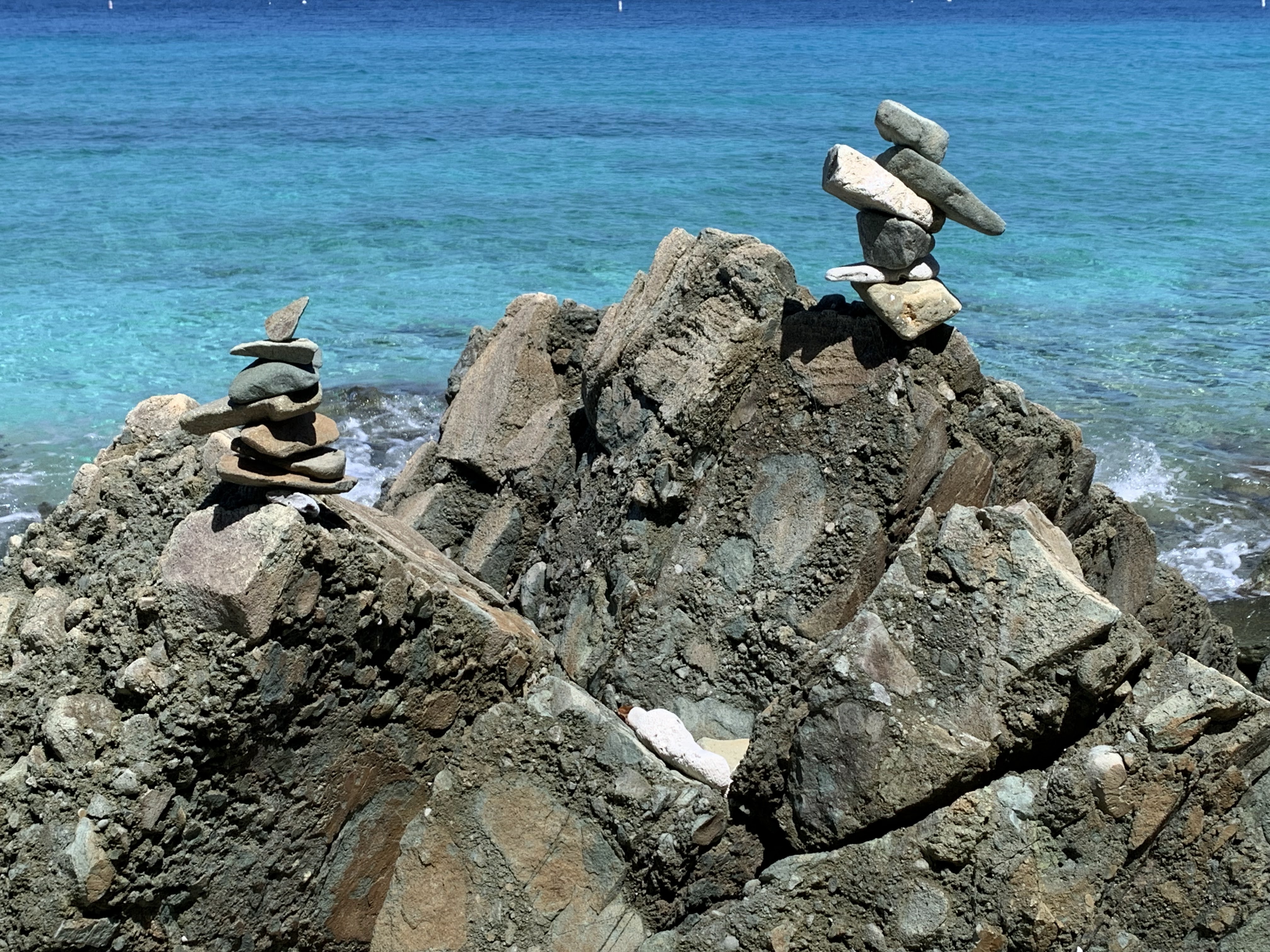
Cairns at Solomon Bay. I stacked the one on the left.

My sister climbing out of Solomon. Most of the trail follows the contour of the hill, but there are a couple of steep rocky places. We did pretty darn good for a couple of old broads.

Iguana on the trail to Solomon.

Magens Bay, St. Thomas.
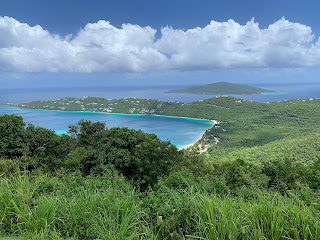
Sunrise from St. Thomas looking east down Sir Francis Drake Passage.
Yes, that Sir Francis Drake. He did sail through the passage. 
The island to the left is Tortola, British Virgin Islands.
St. John is to the right. A mere quarter of a mile separates the BVI from the USVI.

Fort Christian, St. Thomas. The first building constructed after the Danes took possession of the islands. The first phase of its building began in 1666 and was finished between 1671 and 1680.

This is the third iteration of the Lutheran Church to be built on this site and dates to 1793. 
It is the oldest established church in the islands, dating back to about the time the fort was built.

Hotel 1829. 
After being shuttered for many years, 
new owners are giving this beautiful hotel a facelift and hopefully will soon be reopened.
The most precious part of this building is the large Tiffany stain glassed window from 1910.

The Sewer.

Being Thankful
Today I'm ever so thankful for the month I got to spend on my island home with family and friends.
Even went through tropical storm Ernesto! 

What are you thankful for? Did you go anywhere special this summer? Did you have any good English teachers?

Monday, July 8, 2013

Spirit Trees - Part Two

Last week I wrote a little bit about Spirit Trees, trees that at one time people in the Virgin Islands believed contained spirits. This week is not about Spirit Trees as such. It's about trees that have been around for a long time, old trees that I feel deserve some special attention. If these trees don't have spirits in them, they ought to.


In south east corner of Emancipation Gardens on St. Thomas, grows an ancient casha tree. This particular brand of Acacia (in the Mimosa family) is native to the Caribbean. How it managed to
survive is fodder for a story because these trees have brutal inch and a half to two inch long thorns that can pierce tires and shoe soles. It has lived through a time when the ocean lapped a few feet away, through the making and paving of streets and building of buildings. For some reason it was never targeted as a nuisance tree that should be gotten rid of. Instead, it was allowed to grow and its twisted ropy trunk is a wonder to behold.

Down the street from Emancipation Gardens is a park which dates back to 1764 and was originally called Coconut Square. In  1945 it was renamed Roosevelt Park to honor a visit made by Franklin D. Within the park are two baobab trees, the seeds of which were brought to the islands with slaves. These trees were definitely thought of as sacred because they provided food and shelter. There is one baobab on St. John (click on the link and you can see a picture of it) and another on St. Croix which is about 250 years old. Because these trees are basically filled with water they don't have rings so age is approximated by the diameter of the trunk. I have no idea how the trees are in Roosevelt Park, but they must be at least 200 years old. 

On St. John at Cinnamon Bay - home of the National Park Campground - there is this huge rain tree. They are native to Central and South America and probably came into the Caribbean with the various Indians as they migrated up the chain. That's my friend, Margaret on the left and me giving you an idea of its size.

The lignum vitae, also known as ironwood, is a very slow growing native of the Caribbean. The wood is so dense and heavy it sinks in water. Because it is self-lubricating and so hard it is still used for making bearings. It is the national tree of the Bahamas and Jamaica. They only grow to about 40 feet, but don't let the size fool you. This one at Cowpet Bay on St. Thomas is probably several hundred years old...

...as is this one in Cruz Bay, on St. John. As you can see, they tend to branch out low to the ground and make nice shade. Clusters of very pretty purple flowers bloom in the late spring.


I don't know what kind of tree this one is, but it can be found at Magens Bay on St. Thomas. Long ago a storm blew it over, but it kept right on growing. That's Margaret, demonstrating the width of the roots.

And this is a group of classmates posing on the trunk. I'm second from the left.

All of these trees are, to my mind, Spirit Trees. They have survived hurricanes, floods, earthquakes and human beings.

It seems the more gnarled and twisted a tree is, the more we love it. Certainly the older a tree is, the more we cherish it, respect it, honor it. We can see in those places where it has been scarred by life, and in its very rings, the history of time. Those scars give it character and we are awed by its ability to survive. We like to go to these trees and sit beneath them. We like to hug them. Some of us may even talk to them.

I have often wondered why we do not seem to look upon our elder human beings in the same way. Should not their wrinkles, their gnarled and twisted limbs and the scars they bear be as loved and cherished as an old tree?

Tuesday, March 20, 2012

RAIN! And A Little Happy Music

I know, I don't usually post on Tuesdays.

BUT

It's a Happy Tuesday.  We had a three and half inches of rain last night! With lots of lightening and thunder. YEAH! The trees and wild flowers will LOVE it. The river and creeks are UP.

Here are some before and after pictures of the creek near our house.


 This past summer, 2011. Looking northwest.


After last night's rain. Water is actually flowing over the little dam.


This past summer, 2011. Looking southeast. The bald cypress on the left is high and dry.


After last night's rain.


It's amazing what a few inches will do.
We need more, but we'll surely take what we've been given.


It's makes me so happy I decided to share this video with you. The music is by Jamsie and the Happy Seven playing traditional music from the Virgin Islands. The pictures are of St. Thomas, probably during the 1940's and 50s, around the time when I was a kid growing up there. In the pictures the people appear to be poor, but we were all RICH with family, friends and culture. No one went without.

Enjoy!