Blog Schedule

I post on the first Wednesday of every month with an occasional random blog thrown in for good measure.
Showing posts with label Fourth of July. Show all posts

Wednesday, July 3, 2024

IWSG, Butterflies Lollygagging in Your Stomach, Fourth of July Quotes and Being Thankful


Posting the First Wednesday of every month, the Insecure Writer's Support Group, is the brainchild of Alex Cavanaugh. YOU can sign up HERE to participate.

Every month a question will be posed that may prompt you to share advice, insight, a personal experience or story. Remember, the question is optional. You can write about anything that relates to your writing journey.

Let's give a warm welcome to our co-hosts:   JS Pailly, Rebecca Douglass, Pat Garcia, Louise-Fundy Blue, and Natalie Aguirre!
 
This month's question is: What are your favorite writing processing (e.g. Word, Scrivener, yWriter, Dabble), writing apps, software, and tools? Why do you recommend them? And which one is your all time favorite that you cannot live without and use daily or at least whenever you write?

I'd be interested to find out what other people use. I've only ever known Word, which used to be delightfully simple but has grown more complicated as time has marched along. Or...I go old school, pencil and paper. But that, of course, then has to be transcribed into...Word. 
***
Happy Fourth of July!
***
Origins: a recurring post in which I delve into the history of a word or phrase.

Today's phrase is: Butterflies in your stomach
We all know what the phrase means and how it feels, right?
But where did it come from.

Shakespeare Society members performing A Midsummer Night's Dream in the woods
Florence as Puck, transforming Bottom.
Sometimes it's hard to pin down these fluttering flights of fancy that I have. What I did discover is that the American author, Florence Converse, was the first to write it into a novel in 1908, but she used it differently. "...gave him a sad feeling, as if he had a butterfly in his stomach.” Source: theidioms.com. However I couldn't find what novel it came from.

In 1943 it was a paratrooper named Bill Gardener who used it the way we do now, to indicate nervous excitement or anxiety, “I landed all right and although I’ll always have butterflies in my stomach every time I go up …” Source: theidioms.com. And, as we all know, it isn't just a pretty, descriptive phrase, it can be an actual physical sensation.

Today's Weird Word is: Lollygag

It seems to have appeared out of nowhere sometime around 1862. 
It was once spelled "lallygag" and had two meanings: to dawdle (love that word), waste time, dilly-dally, etc. and to kiss, neck, smooch and engage in that sort of love-making. 

It probably came from the the word "loll" which goes all the way back to Shakespeare and has to do with the tongue dripping, drooling, or hanging out of the mouth. Licking a lollypop comes to mind and why it may have first evolved to mean kissing.


Quotes of the Month

"You have to love a nation that celebrates its independence every July 4th, not with a parade of guns, tanks, and soldiers who file by the White House in a show of strength and muscle, but with family picnics where kids throw Frisbees, the potato salad gets iffy, and the flies die from happiness. You may think you have overeaten, but it is patriotism.” – Erma Bombeck

"We on this continent should never forget that men first crossed the Atlantic not to find soil for their ploughs but to secure liberty for their souls. – Robert J. McCracken

"Our country is not the only thing to which we owe our allegiance. It is also owed to justice and to humanity. Patriotism consists not in waving the flag, but in striving that our country shall be righteous as well as strong.” – James Bryce

"America is a tune.  It must be sung together.” – Gerald Stanley Lee

"So let freedom ring from the prodigious hilltops of New Hampshire. Let freedom ring from the mighty mountains of New York. Let freedom ring from the heightening Alleghenies of Pennsylvania! Let freedom ring from the snow capped Rockies of Colorado! Let freedom ring from the curvaceous peaks of California! But not only that; let freedom ring from Stone Mountain of Georgia! Let freedom ring from Lookout Mountain of Tennessee! Let freedom ring from every hill and every molehill of Mississippi. From every mountainside, let freedom ring.” – Martin Luther King Jr.

Being Thankful
Today I'm thankful air conditioning.

What are you thankful for? Does this Fourth feel different to you, or is it just me? 

Wednesday, July 3, 2019

Quotes to Contemplate on the Fourth of July, IWSG


Posting the First Wednesday of every month, the Insecure
Writer's Support Group
, is the brainchild of Alex Cavanaugh. YOU can sign up HERE to participate.

Every month a question will be posed that may prompt you to share advice, insight, a personal experience or story. Remember, the question is optional. You can write about anything that relates to your writing journey.

Let's give a warm welcome to our co-hosts:  Erika Beebe, Natalie Aguirre, Jennifer Lane, MJ Fifield, Lisa Buie-Collard, and Ellen @ The Cynical Sailor!


Happy Fourth of July
It's what I'm thankful for.


Here are a bunch of quotes to contemplate during this holiday.

Stout elderly man in his 60s with long white hair, facing partway leftward
John Adams
“There is nothing which I dread so much as a division of the republic into two great parties, each arranged under its leader, and concerting measures in opposition to each other. This, in my humble apprehension, is to be dreaded as the greatest political evil under our Constitution.” John Adams

"The life of the nation is secure only while the nation is honest, truthful, and virtuous." Frederick Douglas

“You have to love a nation that celebrates its independence every July 4th, not with a parade of guns, tanks, and soldiers who file by the White House in a show of strength and muscle, but with family picnics where kids throw Frisbees, the potato salad gets iffy, and the flies die from happiness. You may think you have overeaten, but it is patriotism.” – Erma Bombeck

“Our country is not the only thing to which we owe our allegiance. It is also owed to justice and to humanity. Patriotism consists not in waving the flag, but in striving that our country shall be righteous as well as strong.” – James Bryce

Gilbert Stuart Williamstown Portrait of George Washington.jpg
Washington
“As Mankind becomes more liberal, they will be more apt to allow that all those who conduct themselves as worthy members of the community are equally entitled to the protections of civil government. I hope ever to see America among the foremost nations of justice and liberality.” – George Washington

“Observe good faith and justice toward all nations. Cultivate peace and harmony with all.”
—President George Washington


James Madison by Gilbert Stuart 1804.jpeg
Madison
“The advancement and diffusion of knowledge is the only guardian of true liberty.” – James Madison

"I do not agree with what you have to say, but I'll defend to the death your right to say it."
—Voltaire

Liberty has never come from the government. Liberty has always come from the subjects of it. The history of liberty is a history of resistance.”
—President Woodrow Wilson

“Here is your country. Cherish these natural wonders, cherish the natural resources, cherish the history and romance as a sacred heritage, for your children and your children's children. Do not let selfish men or greedy interests skin your country of its beauty, its riches or its romance.”
—President Theodore Roosevelt

“Those who deny freedom to others deserve it not for themselves”
—President Abraham Lincoln

"May we think of freedom, not as the right to do as we please, but as the opportunity to do what is right." Peter Marshall

BenFranklinDuplessis.jpg
Franklin
“They who can give up essential liberty to obtain a little temporary safety deserve neither liberty nor safety.”
—Benjamin Franklin

“For to be free is not merely to cast off one's chains, but to live in a way that respects and enhances the freedom of others.”
—Nelson Mandela

“Patriotism means to stand by the country. It does not mean to stand by the president or any other public official, save exactly to the degree in which he himself stands by the country. It is patriotic to support him insofar as he efficiently serves the country. It is unpatriotic not to oppose him to the exact extent that by inefficiency or otherwise he fails in his duty to stand by the country. In either event, it is unpatriotic not to tell the truth, whether about the president or anyone else.”
—President Theodore Roosevelt

America did not invent human rights. In a very real sense, it is the other way round. Human rights invented America.”
—President Jimmy Carter

A stern middle-aged man with gray hair is wearing a dark red suit. He is standing behind a table, holding a rolled up document in one hand, and pointing with the other hand to a large document on the table.
Samuel Adams
“If this nation is to be wise as well as strong, if we are to achieve our destiny, then we need more new ideas for more wise men reading more good books in more public libraries. These libraries should be open to all—except the censor. We must know all the facts and hear all the alternatives and listen to all the criticisms. Let us welcome controversial books and controversial authors. For the Bill of Rights is the guardian of our security as well as our liberty.”
—President John F. Kennedy

“If ever a time should come, when vain and aspiring men shall possess the highest seats in Government, our country will stand in need of its experienced patriots to prevent its ruin.”
—Samuel Adams

Thursday, July 4, 2013

Happy Fourth of July, Free Books, and Thanks


GIRLS ON STILTS

St. John Fourth of July Parade.

In celebration of the Fourth, check out these 
FREE BOOKS

Because everybody who reads likes to have books to read, Sarah's Reviews is giving away THREE (3!) of C. Lee McKenzie's books! Hurry on over there and sign up. I've read all three of these books and they are great. If you don't know who Lee is, you might want to check and see if you're living under a rock. Hop on over to her blog, The Write Game and tell her I sent you!

The Princess of Las Pulgas
After her father’s slow death from cancer, Carlie’s mother is forced to sell their cherished oceanfront home and move the family to the other side of the tracks—to dreaded Las Pulgas. At her tough new urban high school, Carlie is nicknamed “Princess” because of her aloof attitude. But what her classmates don’t know is that Carlie isn’t aloof; she’s in mourning for her father and almost everything else that mattered to her. Meanwhile, her younger brother Keith becomes angrier and more sullen by the day, and even their cat Quicken goes missing, sending Carlie and Keith on a search for her in the hidden orchard beside their seedy apartment complex. They’re met by a rifle-toting cowboy who ejects them at gunpoint from his property. But when Carlie finds him in the kitchen having coffee with their mom the next day, having found and returned the cat, she begins to realize that in Las Pulgas, nothing is what it seems.

Sliding on the Edge

A teenager who is a "cutter" and her grandmother are strangers when they are thrown together, each with secrets that stir mutual distrust until saving a doomed horse unites them and gives each a reason to live.


Alligators Overhead

Twelve-year-old Pete Riley thought being suspended from school was bad, but that’s nothing compared to what happens when a legendary mansion reappears after being gone a hundred years.  When the mysterious, haunted mansion pops up next door, the backwater town of Hadleyville is transformed from boring to bizarre. Pete discovers he’s living among a sadly out of practice coven of witches, his Aunt Lizzie is the leader and the Ornorfree alligators are the witches’ familiars. These swamp animals are in danger of extinction if Aunt Lizzie’s Save the Ornorfree Committee can’t find legal ways to stop developers from destroying another chunk of the swamp. He's struggling to make sense of what’s happening around him when he discovers he might have inherited the family tendency toward witchcraft, but his spells aren’t any better than the out-of-practice witches. When they work some old witchcraft spells, they vanish. He’s scared his spells won’t do much better, but he and his one friend, Weasel, are the only hope for the fragile swamp ecology. It’s up to Pete to harness what he’s come to know are his own strange powers, bring back the Hadleyville witches, and stop the bulldozers.


THANKS

Here's to Carol Kilgore over at Under the Tiki Hut who held and interesting contest with the winner getting to pick one of her books. Guess who won? I had to choose between In Name Only or Solomon's Compass. Well, since Carol featured Solomon's Compass during the A to Z Challenge, I had to go with it. THANKS CAROL!

Wednesday, July 4, 2012

Happy Fourth of July!

I hope each and everyone of you has a wonderful Fourth of July on this, the 236th Anniversary of our Nation's Birth.


Today is also special because I am a GUEST of Nutschell's over at The Writing Nut. This is the first time I've been a guest on someone else's blog. So... if you want to learn a little bit MORE about me (and who doesn't, after all how many Bishes do YOU know) then hop on over and give us a shout.

I look forward to seeing you there!

Monday, July 4, 2011

True Colors

As far as I know, no place in the United States celebrates the 4th quite like they do on St. John. It is a week of celebrating culminating in a parade. I am reprising a blog I wrote back in 2008 as a reminder of the True Colors of these United States and what it means to party. There is no way to describe it except through pictures.

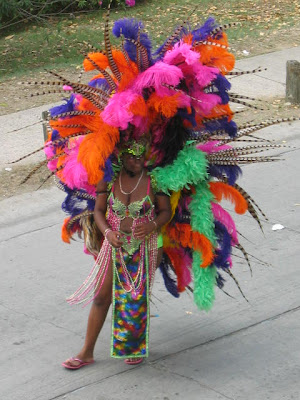
Large beautiful women, scantly clad in colorful costumes, abound. The majority of these women are very physically fit. A typical Fourth of July parade can last five to six hours and they dance and jump and prance the whole time during the heat of the day. They let it all hang out. They should be an inspiration to all large women; that beauty comes in all shapes and sizes.


Music is essential, the louder the better. Between every troop or float there is some kind of music. It might be a steel band, but more often it is an electrified Calypso band or recorded music. A semi pulls a flatbed and the flatbed carries a huge generator which supplies the power to the amps, instruments and mixing boards.
This is just one example of such a semi. The large blue “box” behind the cab is the generator. Look at the size of those speakers! At one point I was holding an empty soda can in my hand and the can was vibrating to the beat of the music. Imagine what was going on in my chest. If you can’t handle loud, the Fourth of July parade on St. John is not the place for you.

Here’s a picture of a young drummer, probably about 12 or 13 years old. He was quite good. Notice the people standing and sitting right next to speakers.

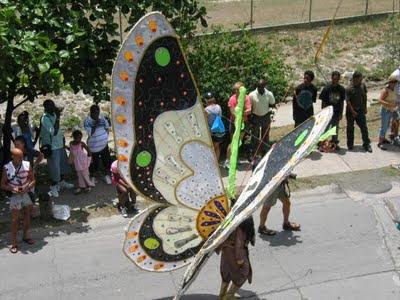
Here’s a man dressed as a large butterfly.

These girls, dressed in patriotic colors, are dancing on stilts and are a good ten feet tall.

Stilt dancing was traditionally preformed only by men. They are called Moko Jumbies. (Jumbies are mischievous spirits. Moko Jumbies are somewhat more serious and perhaps malevolent.) The stilt dancing Moko Jumbie originated in Africa. Years ago, back in the 1950’s and 60’s they wore a unique costume which included long colorful slacks to cover the stilts, a grass skirt, a tall pointed hat and bull whip, which he would crack above the heads of the crowd as he danced and hopped around on one stilt. They were often anywhere from 16 to 18 feet tall.

We don’t see those kinds of Moko Jumbies as much now-a-days. But here’s a picture of two man dressed in a somewhat traditional way. And, you can see how tall the one in brown is, in comparison to the people.

Tourists always have a good time. Here’s a young man surrounded by some lovely ladies. Note the two beers he has in his hand. He’s out to party and have a good time.

Here are Dino and the Flintstones.

There are troops that have been traditional to all parades (Carnival on St. Thomas, Christmas on St. Croix). Some of these troops have been in existence since the 1950’s. Among them are the Indians who always end the parade, the clowns, and the Zulus. Here’s a picture of some of the Zulus.
And a poor donkey made to look like a zebra.

I always wanted to be a clown. But, like the stilt dancers, the clowns were strictly a male only troop (though not anymore.) The clowns in the islands are not at all like the circus clowns most everyone is familiar with. Members who had been in the troop a long time, sometimes had costumes made in velvet patchwork. These costumes were passed down from father to son. Traditionally the costumes where a bright patchwork of calicoes, trimmed with ball fringe, small mirrors and jingle bells. They wore masks, hats and gloves. They also carried whips made from the leaves of the Sansevieria (or mother-in-law’s tongue) which they cracked as they leapt and danced around the legs of the Moko Jumbie. They did this to keep the Moko Jumbie in line, to keep him from disrupting the enjoyment of the crowd. Clowns had a serious job keeping those evil spirits away, hence the whips, bells and mirrors.

Nowadays the clowns sometimes make a political statement, as two are sporting pictures of Obama. Their costumes are made of velvet. Below, notice the whip draped his shoulder.

And that is barely a taste of what the St. John Fourth of July Festival and Celebration is all about.

Have a wonderful day. Eat plenty of watermelon and have a seed spitting contest!

Saturday, July 4, 2009

Friday, April 17, 2009

Tales of Brave Ulysses - The F. D. O.

The first thing you have to realize about the F. D. O. is that she was fast. She was built for speed and she loved to fly.

The F. D. O. could scoot along at the breathless speed of about 25 miles an hour. That may not seem very fast when traveling in a car on a road, but out on the open water, you're booking.

On flat glassy calm days Dad could get her planing. She planed best when it was just Dad, but she planed just fine with two or all four us in the boat. It just took a bit more coaxing. There was nothing so exhilarating as flying across the water with the wind whipping our hair. With the wind whipping away your words and almost making it difficult to breathe. We couldn't do it for long because the least bit of rippling on the water made for a pounding ride, but my heavens it was fun!

On Fourth of July there were boat races. Boats of all sizes and shapes and with all manner of engines and horsepower were divided into somewhat similar categories. The race went from Cruz Bay out and around to a group of rocks called The Brothers, about a mile away, and back to Cruz. It was simple, whoever got back first won.

I think Dad was challenged. I think he may have made bets he could beat just about anyone. He was up against bigger boats with lots more horsepower. Of course it was a slam-dunk. He was already on his way back before the first of the other boats had even made it to The Brothers!

The winner got a case of Schaefer Beer. Dad's favorite brand. The F. D. O.'s reputation was sealed. She won every race she ever entered.

But she wasn't just fast...she was tough too. One time a barge got stuck on The Brothers. Dad went out in the F. D. O. to see if he could help, and by God...with the help of the tide and surge of the waves, he and the F. D. O. pulled that barge off the rocks.

Monday, July 14, 2008

Part II - The St. John Festival

The St. John Festival, celebrating Emancipation and Independence, happens the week of the Fourth, culminating in a noisy, raucous, dance filled parade and fireworks. There is really no way to accurately describe it.

What I can do is post a few pictures of the parade.


Large beautiful women, scantly clad in colorful costumes, abound. The majority of these women are very physically fit. A typical Fourth of July parade can last five to six hours and they dance and jump and prance the whole time during the heat of the day. They let it all hang out. They should be an inspiration to all large women; that beauty comes in all shapes and sizes.


Music is essential, the louder the better. Between every troop or float there is some kind of music. It might be a steel band, but more often it is an electrified Calypso band or recorded music. A semi pulls a flatbed, the flatbed carries a huge generator which supplies the power to the amps, instruments and mixing boards. This is just one example of such a semi. The large blue “box” behind the cab is the generator. Look at the size of those speakers! At one point I was holding an empty soda can in my hand and the can was vibrating to the beat of the music. Imagine what was going on in my chest. If you can’t handle loud, the Fourth of July parade on St. John is not the place for you.


Here’s a picture of a young drummer, probably about 12 or 13 years old. He was quite good. Notice the people standing and sitting right next to speakers.


Here’s a man dressed as a large butterfly.


These girls, dressed in patriotic colors, are dancing on stilts and are a good ten feet tall.

Stilt dancing was traditionally preformed only by men. They are called Moko Jumbies. (Jumbies are mischievous spirits. Moko Jumbies are somewhat more serious and perhaps malevolent.)The stilt dancing Moko Jumbie originated in Africa. Years ago, back in the 1950’s and 60’s they wore a unique costume which included long colorful slacks to cover the stilts, a grass skirt, a tall pointed hat and bull whip, which he would crack above the heads of the crowd as he danced and hopped around on one stilt. They were often anywhere from 16 to 18 feet tall.
We don’t see those kinds of Moko Jumbies as much now-a-days. But here’s a picture of two man dressed in a somewhat traditional way. And, you can see how tall the one in brown is in comparison to the people.

Tourists always have a good time. Here’s a lad surrounded by some lovely ladies. Note the two beers he has in his hand. He’s out to party and have a good time.


Here are the Flintstones and Dino.


There are troops that have been traditional to all parades (Carnival on St. Thomas, Christmas on St. Croix). Some of these troops have been in existence since the 1950’s. Among them are the Indians who always end the parade, the clowns and the Zulus. Here’s a picture of some of the Zulus.


I always wanted to be a clown. But, like the stilt dancers, the clowns were strictly a male only troop (though not anymore.) The clowns in the islands are not at all like the circus clowns most everyone is familiar with. The older clowns, the adults and members who had been in the troop a long time, sometimes had costumes made in velvet patchwork. These costumes were passed down from father to son. Traditionally the costumes where a bright patchwork of calicoes, trimmed with ball fringe, small mirrors and jingle bells. They wore masks, hats and gloves. They also carried whips made from the leaves of the sansaveria (or mother-in-law’s tongue, I don't know how to spell it) which they cracked as they leapt and danced around the legs of the Moko Jumbie. They did this to keep him in line, to keep him from disrupting the enjoyment of the crowd. Clowns had a serious job, keeping those evil spirits away, hence the whips, bells and mirrors.

Nowadays the clowns sometimes make a political statement, as these two who are sporting pictures of Obama. Their costumes are made of velvet.


Here’s a close-up. He is carrying a whip over his shoulder.


And that is barely a taste of what the St. John Fourth of July Festival and Celebration is all about.

Sunday, July 6, 2008

Part I - The Fourth of July

I don’t know that there’s any place in the United States that celebrates the Fourth quite like it’s celebrated on St. John.

To understand the significance one must have a little background. To that end, what follows if a very brief history of the U. S. Virgin Islands.

It all started when Columbus discovered the islands on his second trip in 1493. He landed on St. Croix and was chased off by the fierce and sometimes cannibalistic Carib Indians (for which the Caribbean is named.) Sailing north he came across a string of emerald jewels surrounded by turquoise water. There were so many islands he named them after St. Ursula and her entourage of 11,000 virgins.

The islands were “owned” by different countries over the course of the next several hundred years, including Spain, Britain, Holland, and France. During that time it was mostly pirates who used the harbors to hide out. It wasn’t until 1672 that the Danes established a permanent settlement on St. Thomas.

In 1694 the Danes claimed St. John and built a small fort at Coral Bay, perhaps the most protected harbor in the Caribbean. St. John soon became the home to many plantations and over a thousand slaves. By 1733 conditions for the slave population were abysmal. Hurricanes, drought, an insect plague, crop failures, epidemics of cholera and small pox, a severe code of treatment, along with an influx of slaves who had been royalty, all led to a brutal slave uprising.

The revolt of 1733 was bloody and violent. For six months the slaves held the island of St. John. They were not defeated until the Danes called for help from French troops stationed on neighboring islands. Even then, the leaders of the revolt refused to surrender. Knowing they would die a slow painful death if they did, they chose instead to commit mass suicide. (An excellent historically accurate account of the revolt is told in the book Night of the Silent Drum by John L. Anderson.)

This revolt is the cornerstone, the foundation, on which was built, over the course of the next 100 years, the determination by an enslaved people to be free.

There are many things that happened, many things the slaves did in an effort to win their freedom, but the final straw was a slave revolt on St. Croix which forced Governor Peter von Scholten to abolish slavery. The Emancipation Proclamation was read on St. Croix on July 3, 1848.

This is a picture of the Lord God of Sabaoth Lutheran Church where the proclamation was read.

St. John, home of the first revolt, didn’t get the news until the next day, on July 4th.

In 1917 the islands were bought by the United States. The islanders embraced being citizens and identified with those who fought for their independence from England.

And that’s why the Fourth of July Festival on St. John is celebrated with such enthusiasm. It is a celebration of freedom from slavery and freedom from tyranny, a celebration of the Emancipation Proclamation and the Declaration of Independence.

Coming soon? well, certainly eventually:
Part II - The St. John Festival