Blog Schedule

I post on the first Wednesday of every month with an occasional random blog thrown in for good measure.
Showing posts with label rocks. Show all posts

Wednesday, October 13, 2010

A Rocky Island Picture Show - Part Three

There were rocks we used to climb and play on when we were kids. There was one at the end of of Trunk Bay. It would be located in the foreground of this picture but is not visible.

We kids called it Mush and Porridge Rock. How, why it got that name I have no idea. It was probably a good six or seven feet tall.

At high tide the water swirling around it was deep enough that we could jump off it. But we did more than just jump.


We had a game. We took turns being "it." Whoever was it called out the jump that had to be made. It went like this, "Mush and porridge, cannon ball!" And everyone would have to do a cannon ball. Then the next person would say something like, "Mush and porridge, dancing girl!" And you'd have to see how many can-can kicks you could do before you hit the water. Then it might be "Mush and porridge, belly flop!" Or "Mush and porridge, do the twist!" Or "Mush and porridge, sit like an Indian!" The object was to see how many different ways we could jump off the rock before we ran out of ideas. The first person who repeated him/herself was "the looser."

There is up at Gifft Hill a huge massive tumble of giant stones. It is hidden in the bush. The stones are like a huge cairn and form a cave. One slab-like rock is the floor. On either side of the bottom slab are boulders taller than a man. Resting on top of them, at an angle, is another huge slab. Imagine a clam, it has that kind of shape. The cave formed isn't all that big, but still, it's a cave. Our neighbor Old Man Heber Thomas told us slaves who had escaped into the bush (called maroons) used to hide out there.

It was easy to imagine. The rock cave, though uncomfortable, would have provided some shelter from rain and storms. Down the steep hill-side, not all that far away, is the ghut my sister and I explored that has water in it year round. Maroons would have had access to the water. They could even have grown a few food plants. Near the cave we found an iron hoe used by the slaves in the fields with a genip tree growing through the place where the wooden handle would have been. If the tree has survived I suspect that hoe has been completely encased. I seem to remember there being a aura about the place of people, of things having happened there.

On the North Shore Road of St. John is a large volcanic granite boulder called Easter Rock. Legend has it that early every Easter morning it climbs down the hill and takes a bath in the sea. But you have to up very early, and it happens so fast (faster than the blink of an eye) you can miss the event. In fact no one has ever seen Easter Rock go down to the sea for a sea bath, except the one person who first told the story. But that was so long ago no one remembers the name of the person who saw it happen.

Then there's Carvel Rock, probably named after its resemblance to a caravelle or carvel, a type of ship in the 1700s and 1800s. It's a huge mass of rock, 67 feet tall and 65 yards wide.


Carvel Rock is our family headstone. My grandmother and father are out there. Next year my sister Erva and I will put Mom (who died in April) out there as well. When it's our turn we both plan to be out there too. We'll be with good company, Dr. Oppenheimer and his wife Kitty are out there along with several other people we know.


No flowers needed, no grave up-keep, no concern that someone might come along and vandalize your headstone.

A giant natural cairn.

It'll be there for a long, long time.


Friday is Blog Action Day. The topic is WATER, that wonderful mysterious substance that makes up about two thirds of our bodies and covers about two thirds of our planet. (Coincidence?) So far there 3,224 bloggers registered in 122 countries, with a combined readership of over 25,000,000 people. (That's twenty-five MILLION!) The White House and the UK Foreign Office will also be participating. Come and join me in this world wide GIANT BLOGGING EXPERIMENT. You can register here. It's painless, I promise.

Tuesday, October 12, 2010

A Rocky Island Picture Show - Part Two

There are many rocks that poke their noses out of the ocean, hiding their massive bodies beneath the waves. They have names like The Brothers, Carvel Rock, King's Rock, and The Indians.

Some rocks look kind of like hardened scabs on the the hillside.

If you sit on the left side of the plane when you fly into St. Thomas, you might see is this cliff cave.
This is what it looks like from Brewer's Bay where I took the picture.

It's really quite a massive out-cropping of rock. I believe it and the hillside are owned by the University of the Virgin Islands (but don't quote me on that.) There are nature trails that go up to it, though I have never been. Perhaps the next time I'm down there my sister and I will go. It's amazing how many places there are to explore within 39 to 40 square miles. It's amazing how many people grow up within that space and never get to the other side of the island. It's true, I'm not making that up.

If you sit on the right side of the plane as you fly in, you might catch sight of Sail Rock.
If I see it when I fly in, I get all goose-bumpy. It's my Statue of Liberty. It's the beacon that tells me I'm home. When I leave, I get all weepy, because it's the last glimpse of the Virgin Islands I will have until I return.

As you can sort of see from the picture ( it's several miles off the west end of St. Thomas) it's somewhat triangular in shape. Legend has it that during World War I the Germans fired on it thinking it was a U. S. navel ship. It's true the Germans were prowling the area, but whether or not they was actually fired on it I don't know.

What is also true is that the islands were an important mid-way point between the Old and New World from the time they were discovered by Columbus in 1493. The U. S. bought the islands from Denmark in 1917 to protect the Panama Canal from the Germans. Some of the old wooden barracks that were built at that time are still standing and in use.

The islands were also important during World War II. St. Thomas had a sub-base, a deep water harbor were submarines could dock. There were concrete bunkers, navel barracks, (some of them are still in use as well) and aircraft hangers (the University's gym is built around one.)

It's interesting that such small pieces of rock (I'm talking the islands themselves) have played so many major parts on the world's stage. Sail Rock being one of them.
More rocks tomorrow.

Monday, October 11, 2010

A Rocky Island Picture Show - Part One

I believe I can trace my love of rocks directly to our move to St. John when I was five years old.

The rocks in the islands are beautiful. They are mostly volcanic in origin, which means they are very hard. In fact the islands are made up of some of the hardest rock in the world. It's so hard diamond drill bits break. It's so hard they call it, ahem...blue bitch. It's so hard that houses are sometimes built around boulders that cannot be blasted away. As in this picture.


At our guest house at Lille Maho there was a three foot tall somewhat triangular shaped rock around which was build our back porch. It stood defiantly between the bedrooms and bathrooms and was the cause of many night-time bruised shins and busted toes, not to mention choice curse words.

The rocks in the islands are filled with different colors, textures. They can be various shades of blue, which is where blue bitch gets its name. They can be veined with quartz. They can be rusty orange, evidence of iron in their blood. They can be grey or black. Each has its own shape.

This is a typical stacked stone wall. It is several hundred years old, built during the slave days.


Here's the windmill at Annaberg on St. John. When I was little a family actually lived in it. There was second floor made wood.

This is the outside wall of boiling house at Annaberg, where sugar cane juice was boiled down to make sugar. Side products were molasses and rum. You can see yellow and orange brick. They came from Europe as ballast on the sailing ships. The arched "holes" are where the fires were built.


This is inside the boiling house. That round thing in the center is one of the iron boiling pots. Under it is one of those holes where the fires were. Look at all those rocks! Each one placed there by the hands of slaves.

The next three pictures are taken at the Pissarro Building on St. Thomas. I like to imagine Camille as boy running through this particular alleyway, seeing these colors, which later translated and his wonderful ability to capture color and light in his paintings. I like to think it all started here, with these rocks and bricks. Truth be told, the walls were probably plastered when he was a kid in the 1830s and 40s.


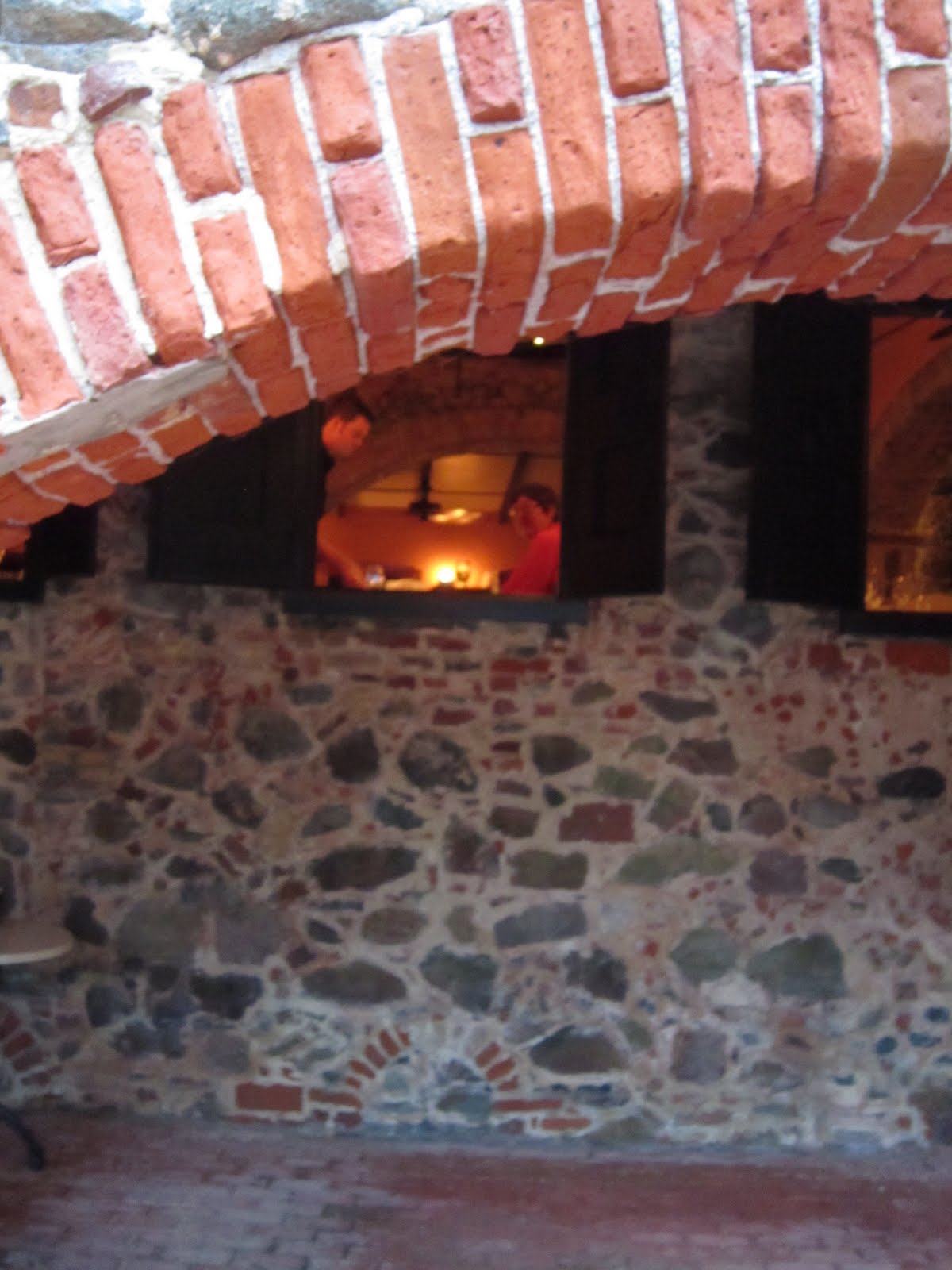
This last picture was taken at the Old Stone Farm House, now a restaurant. Through the window you can see my sister being served by a waiter. Originally is was a dairy farm. Cows were milked where she is sitting. This dairy farm goes back to Danish times and was still in operation when I was growing up. My sister went to school with the owner's daughter. They were classmates. The building is several hundred years old.


I have many pictures of stone buildings. These are just a few examples.
My next post will be about particular rocks, rocks that have names, rocks that have stories.